
Where It All Began — In a Boardroom
Some rivalries are born on track. The greatest rivalry in motorsport history was born in a boardroom.
In 1963, Enzo Ferrari was facing a financial crisis. His road car operation could no longer fully fund his racing dreams, and he began searching for a corporate partner with deep enough pockets to keep the Scuderia alive. Henry Ford II had grand plans to expand worldwide, and motorsport success was seen as the ideal launch pad. The two giants entered negotiations for Ford to purchase Ferrari, and for a time it seemed a deal would be struck.
Then Enzo walked away. At the eleventh hour, he decided he could not hand control of his racing programme to an American corporation. The deal collapsed, and Henry Ford II — furious, humiliated, and burning for revenge — made a decision that would reshape motorsport history forever.
He made it his personal mission not just to beat Enzo Ferrari, but to embarrass him — and his battlefield of choice was the Circuit de la Sarthe and the 24 Hours of Le Mans.
What followed was one of the most audacious projects in automotive history.
The GT40 and Four Years of Dominance
By 1964, Ferrari had won the Le Mans 24 Hours five times in six years. The Italian marque was an unstoppable force in sportscar racing. Ford threw millions of dollars at the problem, recruited the brilliant Carroll Shelby to lead the programme, and developed a car specifically designed to go to La Sarthe and destroy Ferrari: the GT40 — named for its impossibly low 40-inch roofline.
The early years were humbling. Ford’s cars were fast but fragile, retiring repeatedly while the Ferraris ran on. The Nordschleife, the rain, the night — Le Mans stripped every weakness bare. But Ford was learning, and Ford was relentless.
Then came 1966. Ford defeated Ferrari at the 24 Hours of Le Mans with the Ford GT40 Mk II, securing its first overall victory after years of failed attempts. The GT40s finished first, second, and third — a complete, emphatic humiliation of Ferrari on the grandest possible stage. It was the first time an American manufacturer had ever won the most famous race in the world.
Ford’s GT40 won Le Mans four times between 1966 and 1969, and with it shattered Ferrari’s dominance of endurance racing entirely. In just three years, Henry Ford II had achieved his goal. The Italian company would never take an outright win at the French event again during that era.
The rivalry became legend. It inspired books, films, and generations of motorsport fans. And then, for over half a century, Ford stepped away from the top class of Le Mans competition — competing in GT categories but never again challenging for the outright win that had defined its greatest chapter.
Until now.
The Announcement That Changed Everything
The news was announced by Ford Motor Company Executive Chair Bill Ford during Ford Performance’s annual season launch event in Charlotte, North Carolina, in the presence of some 2,000 guests and 50 drivers from Ford’s global motorsport activities. Ford Motor Company would return to the top tier of endurance racing. In 2027, the Blue Oval would be back at Le Mans fighting for overall victory for the first time in nearly six decades.
The room, by all accounts, erupted.
Ford President and CEO Jim Farley left absolutely no ambiguity about the intention: “Bringing Ford back to the top class at Le Mans has always been a dream for many of us including our Executive Chair Bill Ford. We are coming back to Le Mans to win, and we aren’t making that a secret. On Sunday, it will be exactly 56 years since we last took the top step of the overall podium here. That is long enough. In 2027, we are coming with the same level of expectation, and we are entrusting ORECA to help us take on Ferrari and the other top-class teams as we did back in the 1960s.”
Sixty years. And Ford haven’t forgotten a single one of them.
The Car — Built From the DNA Up
Every decision Ford has made in building its Hypercar speaks to identity, heritage, and intent.
The chassis will be designed and built by ORECA — the celebrated French race car manufacturer with decades of winning experience in prototype racing, and a partner whose LMP2 car has become the benchmark of its generation. It is a chassis platform Ford can trust to be fast, reliable, and dialled-in from the first test.
But it is the engine choice that tells you everything you need to know about what Ford is doing here.
The car will be powered by a naturally aspirated 5.4-litre V8 — the Coyote — sharing the same architecture as its Mustang GT3, mated to the spec LMDh hybrid system supplied by Bosch. In a field dominated by turbocharged units, Ford is going to Le Mans with a big, naturally aspirated American V8. It is a statement as much as a technical decision — a declaration of who Ford is and where it has come from.
Programme manager Dan Sayers put it perfectly: “When you hear a Ford coming down the Mulsanne Straight at three in the morning, you shouldn’t have to look at the badge to know who it is. That is why we chose the Coyote.”
For the first time in the company’s history, this competition engine is being produced entirely in-house, with the team in Dearborn working alongside Red Bull Ford Powertrains. As of early 2026, the first engine had completed its build, was on the dyno, and had been testing for a period of time — working through basic calibration tasks and beginning development of performance aspects, with the hybrid system also running on the full powertrain dyno. The programme is on schedule. The machine is coming to life.
The Drivers
Ford’s driver lineup blends youth, experience, and symbolism in equal measure.
Mike Rockenfeller — “Rocky” to the paddock — is the veteran anchor of the programme. A Le Mans winner in 2010 with Audi and one of the most respected endurance racers of his generation, he brings the kind of racecraft and experience that wins 24-hour races.
Sebastian Priaulx is the pure natural talent of the group — a proven GT racer and Ford factory driver who, alongside Rockenfeller, took the Mustang GT3 to victory in two rounds of the IMSA WeatherTech SportsCar Championship in 2025. The two will also contest the 2026 European Le Mans Series together in LMP2, building their partnership ahead of the Hypercar debut.
Then there is Logan Sargeant — and his inclusion carries its own beautiful weight of history. The 25-year-old Floridian brings Formula 1 technical experience and high-downforce expertise from his 36 Grands Prix with Williams. But more than his CV, his nationality matters enormously.
Sayers highlighted the symbolic significance: “Having an American back in a Ford at Le Mans feels right. It’s a nod to giants like Dan Gurney and AJ Foyt, who showed the world in 1967 what happens when American grit meets global ambition.”
An American driver. An American V8. An American team. Going to France to take on Ferrari. The echoes of 1966 are entirely intentional.
Ford vs Ferrari — The Rivalry Reborn
Here is the element that elevates this story from exciting to historic.
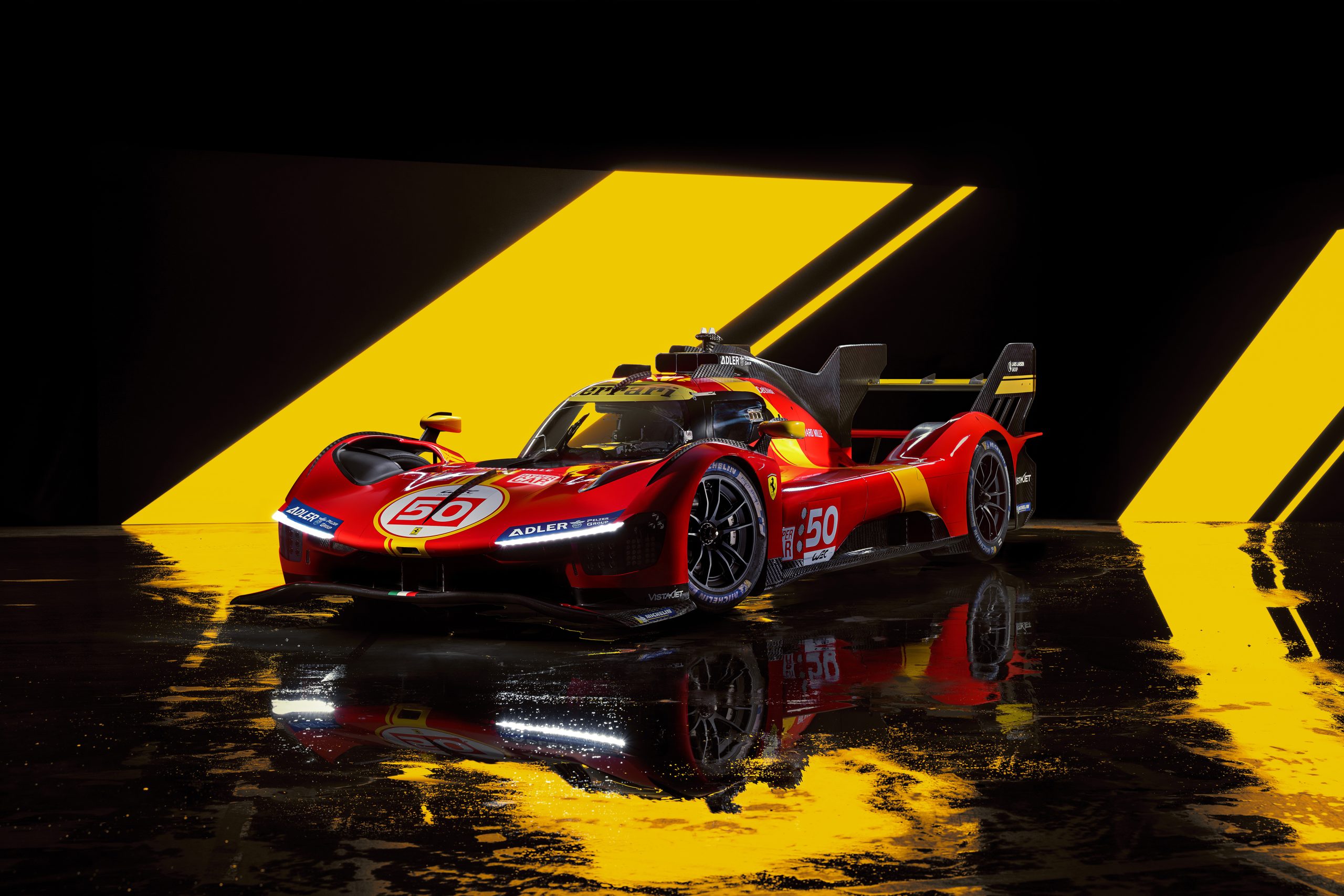
Ferrari is currently one of the dominant forces in the FIA WEC Hypercar class. The Scuderia returned to Le Mans in 2023 and won at their first attempt — a moment that sent shockwaves around the motorsport world and reminded everyone that the Prancing Horse is never far from the top step of the podium at La Sarthe. They remain a benchmark against which every other Hypercar programme measures itself.
Into this landscape rides Ford — the one manufacturer whose history with Ferrari at Le Mans is not just competitive, but deeply, personally, unfinished. The grudge that began in a corporate boardroom in 1963, that fuelled four consecutive Le Mans victories and rewrote the history of endurance racing, is about to be reignited.
Dan Sayers framed the challenge with characteristic bluntness: “To build a Hypercar programme from a blank sheet of paper to a Le Mans start line in just two years is, by any objective measure, almost impossible.” But Ford is doing it anyway. Because that is exactly what they did with the GT40. Because impossible has never stopped them before.
What Awaits in 2027
The 2027 FIA World Endurance Championship will be unlike any season in the modern era of the sport. Ferrari. Toyota. Porsche. BMW. Alpine. Aston Martin. McLaren. And now Ford.
The grid reads like a roll call of automotive greatness — and at its centre, for the first time in over half a century, will be the Blue Oval in full factory colours, chasing the outright win at Le Mans that has belonged to other people for 57 years.
Ford’s programme manager Sayers ended his 2026 season launch address with words that echoed around the paddock: “We have the engine. We have the drivers. We have the vision. We are building more than just a car; we are building a legacy. We are reclaiming our seat at the top table of endurance racing. We are America’s Race Team, and we are coming for the world.”
When that Le Mans grid forms up in June 2027 and the lights go out on the 95th running of the greatest race on earth, somewhere in the night air above the Circuit de la Sarthe, the ghosts of Ken Miles, Carroll Shelby, Dan Gurney, and AJ Foyt will be watching.
Ford is back. Ferrari is waiting. And the greatest rivalry in motorsport history is about to begin again.
Comments are closed